Coachbox Fitness Trend
What is the "Coachbox Fitness Trend?"
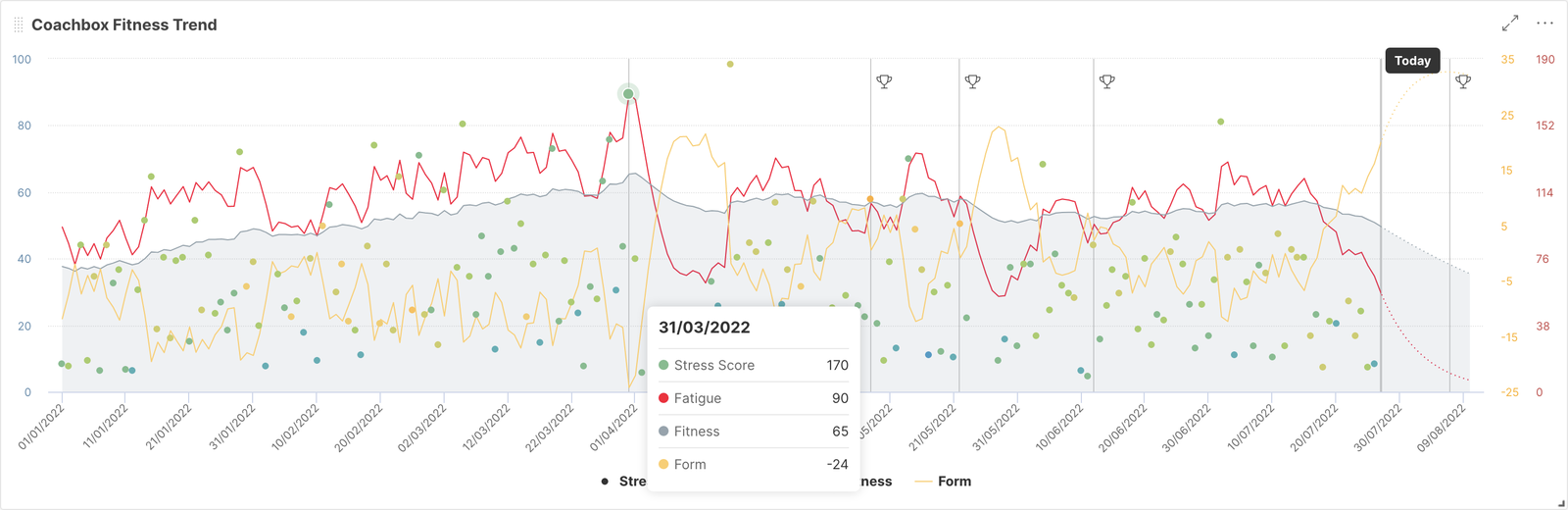
The "Coachbox Fitness Trend" chart allows you to track how good your fitness is, how tired you are, and how good is your ability to achieve.
Your form is high or "peaking", when your fitness is very good, but you are not tired. This is indicated as the difference between the fitness score and the fatigue score.
Your body's response to different efforts made over time are modeled in this graph. Your body responds to these stimuli with fatigue and afterwards creates what is called "supercompensation" which ensures that you recover better than before for any subsequent efforts.
To make full use of the fitness you have acquired, your ability to achieve must be up to par, which means that you have overcome fatigue with rest and recovery. To quantify fitness, fatigue and form over time, each effort must be quantified. This is what the "Stress Score" is used for.
A "Stress Score" can be calculated when the thresholds for an athlete have been entered in the corresponding training zones. These are the fields that you can find at the bottom of the training zones. The only mandatory threshold that must be filled in is the "Anaerobic threshold". When the other thresholds are not filled in manually, an automatic estimation will be made. Therefore, the more correctly the thresholds (e.g. from a test) are filled in, the more accurately the "Stress Scores" can be calculated.

- Condition is a 42-day exponentially weighted moving average of your Stress Score.
- Fatigue is a 7-day exponentially weighted moving average of your Stress Score.
- Form is your fitness minus fatigue. To build fitness, you must create stress by increasing the training load (fatigue higher than fitness) resulting in negative performance. Reduce training leading up to important races and in periodic rest weeks to recover.
What is the "Stress Score?"
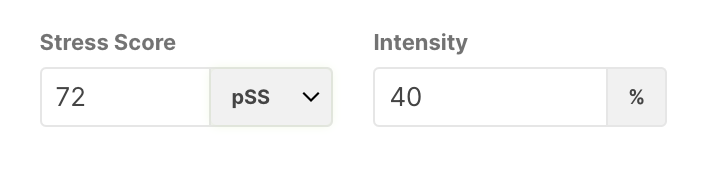
The "Stress Score" is a value assigned to each training session. This value is an estimate of how strenuous a particular activity was in relation to the athlete's capabilities. It takes into account both the duration and intensity of the activity. A one-hour workout at the anaerobic threshold gives a "Stress Score" of 60.
What types of "Stress Scores" are there?
- pSS: The Power Stress Score is calculated from the measured power on the basis of the physiological power thresholds
- hrSS: The Heart Rate Stress Score is calculated from the measured heart rates based on the physiological heart rate thresholds
- vSS: The Velocity Stress Score is calculated from the measured speed/pace based on the physiological thresholds
What preference is given by sport?
Cycling
- Power (pSS)
- HR (hrSS)
Running
- Speed/Pace (vSS)
- Power (pSS)
- HR (hrSS)
Swimming
- Speed/Pace (vSS)
- HR (hrSS)
How is the "Coachbox Stress Score" different from others?
Each sport has its own characteristics and will stress the body differently (e.g. running vs. cycling). The "Coachbox Stress Score" tries to reflect the different characteristics of the sports in the scores so that the training load for people who combine several sports (e.g. triathletes) is really representative of the total load on the body.
Moreover, Coachbox has chosen to develop the methods in such a way that the different measurement methods (heart rate, power, speed, ...) and the corresponding calculation methods are physiologically underpinned in a similar way and can thus be related to each other.
Why does my workout have no Stress Score?
Two things have to line up: zones that apply on the day of the workout for that sport, and recorded data of the type those zones are built on. Miss one of the two and the field stays empty.
- There are no zones for that sport. Without a zone set, no workout in that sport gets a score. Add one under training zones.
- The zone set starts after the workout. A zone set applies from its own date onwards, so older workouts fall outside it. Move that date back or add a zone set with an earlier start date, and Coachbox recalculates the workouts in that period automatically.
- The anaerobic threshold is empty. It is the only threshold you have to fill in yourself: Coachbox derives the aerobic, VO2max and maximum threshold from it as long as you leave them blank. Without the anaerobic threshold there is no score.
- The workout holds no data of the right type. If your zones are power only and you rode without a power meter, there is nothing to calculate from. Fill in heart rate zones as well and Coachbox falls back on those, following the per sport order above.
Why is there a TSS but no Stress Score?
That is almost always down to the sport. The Coachbox Stress Score weighs each zone differently per sport, and those weights exist for running, cycling, swimming, rowing, skiing, skating, walking and snowboarding. For other sports (strength training, tennis, ...) the Coachbox Stress Score stays empty. TSS only needs your anaerobic threshold, so it does show up there.
What is the "Intensity" score?
The "Intensity" score is an indication of how hard or difficult an activity was in relation to your current fitness level.
This score is easily calculated by dividing the Stress Score by the duration of the activity (in minutes). Thus, a one-hour workout at the anaerobic threshold gives an intensity score of 100%.